Wednesday, 5 August 2026
Building an FT8 Digital Interface – Dive into Digital Modes
Building an FT8 Digital Interface – Dive into Digital Modes: This blog post examines a well-designed FT8 digital interface circuit that provides both audio coupling and PTT (Push-to-Talk) control.

Sunday, 17 May 2026
Build a High-Sensitivity Regenerative Receiver with 2N7000 MOSFET
The High-Sensitivity Regenerative Receiver is a classic single-transistor radio that combines simplicity with surprisingly high sensitivity. By using controlled positive feedback, the circuit operates just below oscillation, dramatically increasing gain and selectivity. With the correct coil and tuning capacitor, it can receive medium-wave broadcast, amateur HF bands, and shortwave broadcast stations using only a 3-volt supply.
Because this is a single-tuned regenerative design, frequency coverage depends almost entirely on the inductance of the main tuning coil. Each coil is therefore optimized for one band or a portion of a band.

Friday, 15 May 2026
Reverse Beacon Network: The Ultimate Guide for Ham Radio Operators
The Reverse Beacon Network represents a clever inversion of traditional radio beacon concepts. While conventional beacons are transmitting stations that operators listen to for checking band conditions, the RBN turns this model on its head by creating a global network of listening stations that hear you. When you key up your transmitter and send CW, RTTY, or PSK signals, hundreds of automated receiving stations scattered across continents are potentially listening and ready to report your presence.
The network was originally built around CW contesting and remains strongest on Morse code. However, many skimmers now also support RTTY and other digital modes.
This network operates through the dedication of volunteer amateur radio operators who run specialized receiving stations equipped with software-defined radios and decoding programs. These stations work tirelessly around the clock, monitoring the amateur bands and automatically decoding callsigns from the signals they detect. The moment one of these stations successfully decodes your transmission, it uploads that information to a central database where operators worldwide can access it within seconds.

Thursday, 14 May 2026
Low-Loss Feedline on a Budget: Building 450 to 600 Ohm DIY Ladder Line
DIY Ladder Line for the HF Ham A complete technical guide to building, routing, and using open-wire balanced feedline at your station
Ladder line is a type of feedline made of two parallel wires held apart by small spacers at regular intervals. When you look at it from the side it looks exactly like a ladder — hence the name. The spacers keep the wires a fixed distance apart all the way from the antenna down to your radio room.

Unlike coax cable, which has a center conductor buried inside solid plastic and covered by a metal braid, ladder line is open to the air. This is not a flaw. It is actually its biggest strength. Air is one of the best insulators there is, and it does not eat up your signal the way solid plastic does.
The two wires carry equal and opposite signals. Because they are close together and balanced, the fields from each wire mostly cancel each other out. Very little energy radiates from the feedline itself. This means nearly all your transmitter power reaches the antenna, where it belongs.
3 x 5/8 Collinear antenna for 435 MHz UHF Band
For UHF repeater systems operating around 435 MHz, antenna efficiency and gain are critical. Simple vertical antennas often do not provide sufficient performance, especially when wide coverage and reliable signal strength are required. To address this need, a UHF collinear antenna design adapted from the well-known Diamond BC-200 has been developed and documented by Kostadin Evstatiev (LZ1DJ).
This 3 x 5/8 Collinea antenna is intended specifically for the 420–440 MHz band and provides high gain without requiring post-installation tuning when constructed accurately.

Wednesday, 13 May 2026
DIY Antennas for LoRa and Meshtastic: A Complete Guide to 433, 868, and 915 MHz
LoRa radios offer incredible long-range, low-bandwidth communication—but only if your antenna is up to the task. A poor antenna can limit you to a few hundred meters, while a well-built DIY design can push past 20 km. The best part? You can build proven, high-performance antennas for just a few dollars.
This guide covers everything you need to build your own LoRa antennas for LoRa and Meshtastic 433 MHz (Europe/Asia/amateur radio), 868 MHz (EU), and 915 MHz (North America/Australia). You’ll find exact dimensions, construction tips, band-specific trade-offs, and real-world performance comparisons.

Stock antennas that ship with LoRa modules, Meshtastic nodes, and Helium Hotspots are typically tuned for minimal cost rather than maximum performance. They’re often mismatched to your specific frequency, use cheap materials, and have poorly characterized radiation patterns.
Tuesday, 12 May 2026
OXO QRP HF Transmitter
The OXO QRP HF transmitter is a simple, low-power CW (continuous wave) transmitter designed by George Burt, GM3OXX. It is a single-band transmitter that can be built to operate on any of the amateur radio bands from 160 to 20 meters. The transmitter is built around a few standard transistors and a crystal oscillator. It is an elementary circuit to build, and can be assembled from a kit or from scratch.

The OXO transmitter is a QRP HF transmitter, which means that it produces a very low output power. This makes it ideal for making short-range contacts with other amateur radio operators. The OXO transmitter can also be used for experimentation and learning about radio electronics.
Building Sovina 40M Class E CW Transmitter with BS170 MOSFETs
The Sovina 40m Class-E CW Transmitter is a compact and highly efficient HF transmitter designed specifically for amateur radio operators who enjoy homebrew QRP equipment. This circuit is based on the original work by PY2OHH (Roberto S. Soria) and has become popular due to its simplicity, excellent efficiency, and clean RF output. This CW Transmitter is particularly noted for its reliability and performance.

Monday, 11 May 2026
Complete Guide to Budget Software Defined Radio : From $15 Dongles to Serious HF Receivers
Software Defined Radios have quietly rewritten the rules of radio listening. What once demanded a shelf full of dedicated hardware — separate receivers for HF, VHF, UHF, satellite — now fits into a USB dongle the size of your thumb. For hobbyists and shortwave listeners working on a tight budget, that shift is nothing short of revolutionary.
This guide covers the full landscape of affordable SDRs: what to buy at each price point, which software tools matter, and how to avoid the traps that catch most beginners.
Friday, 8 May 2026
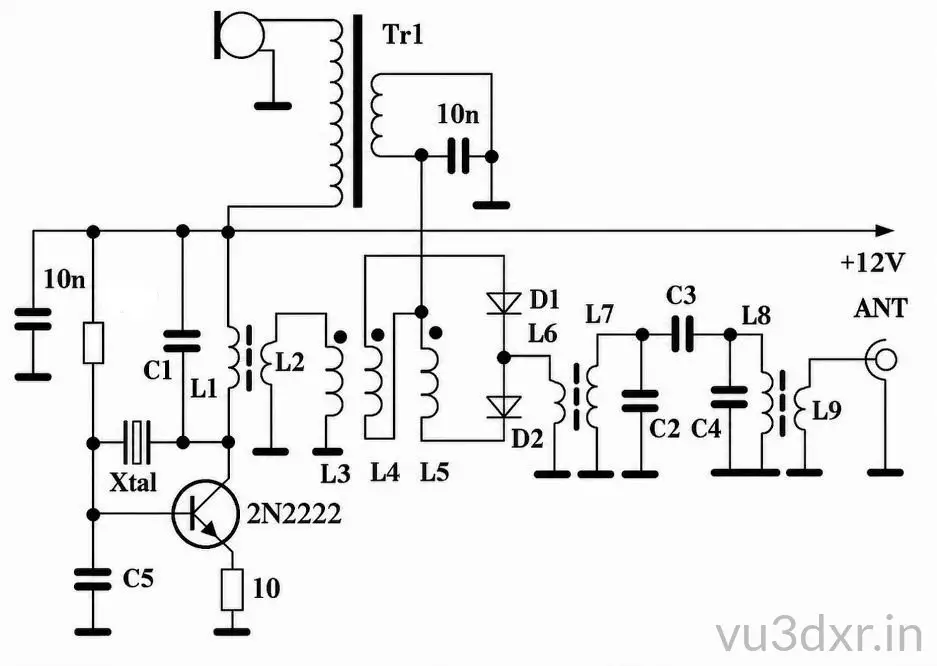
Building a Simple 2N2222 DSB Transmitter for Amateur Radio
Minimalist RF circuits often teach more than complex modern designs. This small DSB transmitter is a good example. The entire DSB transmitter uses only one active semiconductor device together with a pair of diodes and a few tuned circuits.
At first glance the circuit almost looks too simple to work seriously. Yet it does. When connected to a properly matched antenna, the transmitter can establish contacts with ordinary SSB stations surprisingly well. Most operators on the other end will hardly notice that the signal comes from such a basic setup because the carrier is largely suppressed.
The original concept was published by the well-known experimenter JF1OZL and later reproduced by several European homebrew enthusiasts. Its appeal comes from one thing: simplicity.
Thursday, 7 May 2026
ATS Mini Firmware Now Supports LILYGO T-Embed SI4732
ATS Mini Firmware Now Supports LILYGO T-Embed SI4732: ATS Mini firmware v2.34 now includes experimental support for the LILYGO T-Embed SI4732 receiver. Here is what the hardware does, how ATS Mini firmware works,
Monday, 27 April 2026
Full Wave Loop Antenna for VHF UHF FM Radio Bands
Looking to upgrade your VHF/UHF setup without complicated gear? Try building a full-wave loop antenna.
This design uses a loop with a perimeter equal to one wavelength, giving you better efficiency and a more balanced radiation pattern compared to basic antennas.
Why hams love it:
• Lower noise pickup (great for cleaner signals)
• Around 2 dB gain over a dipole
• Works across VHF, UHF, and even FM bands with simple scaling
It’s compact, easy to build, and surprisingly effective for both transmitting and receiving.
If you enjoy DIY radio projects, this guide walks you through dimensions and construction step by step:
🔗 https://vu3dxr.in/full-wave-loop-antenna-for-vhf-uhf-fm-radio-bands/
VHF DXing Secrets: The Ultimate Guide to Tropospheric Ducting for Radio Hams
Ever heard signals travel hundreds or even thousands of kilometers beyond line-of-sight? That’s not magic—it’s tropospheric ducting.
This fascinating radio phenomenon happens when atmospheric conditions (like temperature inversions and high-pressure systems) bend and trap VHF/UHF signals, letting them travel far beyond their normal range.
For ham radio operators, this means unexpected DX contacts, strong distant signals, and sometimes even interference from stations you’d never normally hear.
If you’re into radio, propagation, or just curious how the atmosphere can act like a giant waveguide, this guide is worth your time:
🔗 https://vu3dxr.in/ultimate-guide-to-tropospheric-ducting-for-radio-hams/
Microphone Preamplifier with Audio Peak Limiter
Microphone Preamplifier with Audio Peak Limiter: Build a simple microphone preamplifier with audio limiter using 2N3904 transistors and 1N34 diodes. Ideal for ham radio, DIY audio, or voice processing
Subscribe to:
Posts (Atom)